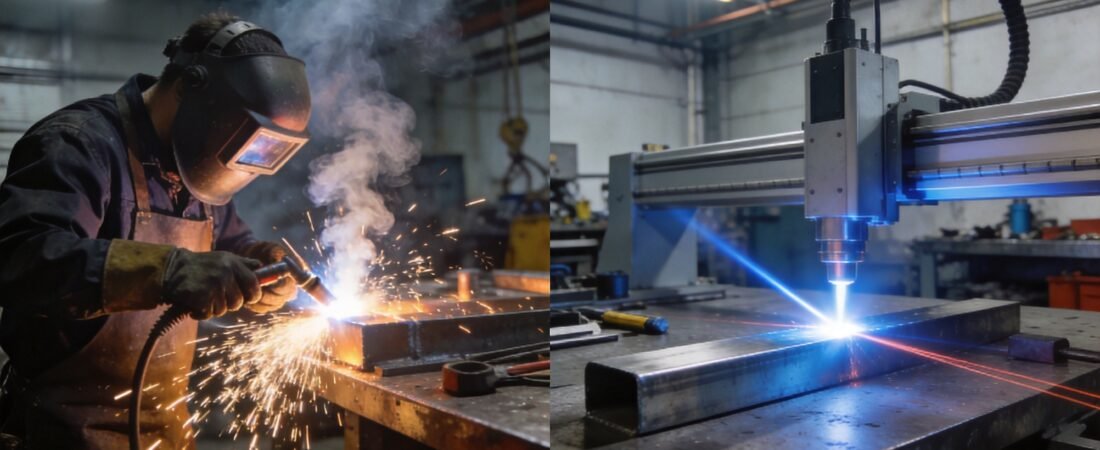
Laser welding is transforming the metal fabrication industry — but is it the right choice for your business? While traditional welding methods like TIG, MIG, and stick welding have been the standard for decades, handheld fiber laser welders are rapidly gaining popularity. Let’s break down the differences.
How Laser Welding Works
Laser welding uses a high-energy fiber laser beam to melt and join metals. The focused beam creates a small, precise weld pool with minimal heat input. Modern handheld laser welders make this technology accessible even for small workshops.
Speed Comparison
Laser welding is typically 4-10 times faster than TIG welding and 2-5 times faster than MIG:
Stick Welding: 0.5-1 m/min
TIG Welding: 0.8-1.5 m/min
MIG Welding: 1.5-3 m/min
Laser Welding: 3-10 m/min
For production environments, this speed advantage directly translates to higher output and lower labor costs.
Weld Quality
Laser welding advantages:
Small heat-affected zone — less warping and distortion
Deep penetration — single-pass welds on thicker materials
Clean, smooth finish — often requires no grinding or polishing
Consistent quality — less dependent on operator skill
Traditional welding advantages:
Better for thick structural welds
Easier filler metal flexibility for gap bridging
Standard welding PPE is sufficient
Material Compatibility
Carbon Steel: Laser ✅ Excellent | TIG ✅ Good | MIG ✅ Good
Stainless Steel: Laser ✅ Excellent | TIG ✅ Good | MIG ✅ Fair
Aluminum: Laser ✅ Good | TIG ✅ Good | MIG ✅ Good
Copper: Laser ✅ Good | TIG ⚠️ Difficult | MIG ⚠️ Difficult
Galvanized Steel: Laser ✅ Good | TIG ⚠️ Porosity issues | MIG ⚠️ Porosity issues
Laser welding handles dissimilar metals and reflective metals much better than traditional methods.
Cost Comparison
Traditional welding setup: $500 – $5,000
Handheld laser welder: $3,000 – $15,000
Laser welding has lower consumable costs and lower labor costs due to faster speed
ROI Example: If a TIG welder takes 8 hours to complete a job that a laser welder finishes in 2 hours, the labor savings alone can pay for the laser welder within months.
When to Choose Laser Welding
Choose laser welding when:
You weld stainless steel, aluminum, or copper regularly
You need high production speed
Clean weld appearance matters
You’re welding thin materials where warping is a concern
Stick with traditional welding when:
You do heavy structural welding outdoors
Your budget doesn’t allow for laser equipment
You only weld occasionally
The Hybrid Approach
Many modern fabrication shops use laser welding for production work and keep traditional welding for field repairs and heavy structural work — the best of both worlds.
Conclusion: For most metal fabrication businesses, handheld laser welding is a worthwhile investment that pays for itself through faster production, better weld quality, and lower finishing costs.